In November 2026, a major cyberattack reported by Newsweek exposed security risks affecting some of the world's most recognizable media and technology companies. Researchers identified 188 infected Optimizely JavaScript snippets associated with 178 organizations. These findings illustrate the scale of potential exposure, rather than the number of confirmed data theft cases.
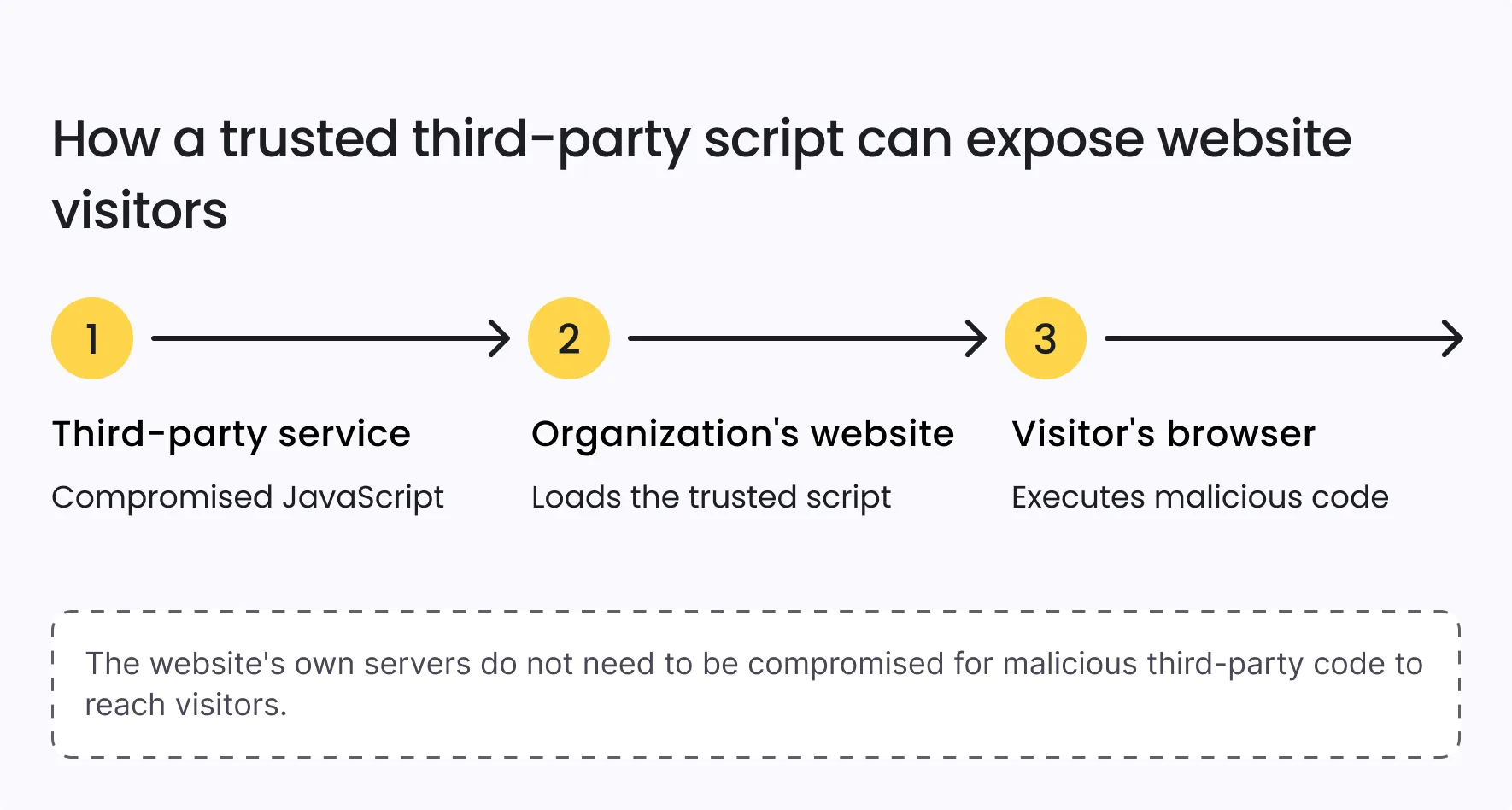
Attackers exploited a vulnerability in Optimizely, a widely used website experimentation platform, to distribute malicious JavaScript through a trusted third-party service. The incident demonstrated how attackers can reach visitors across multiple websites without directly compromising those websites' servers.
As organizations prepare their website security strategies for 2027, the Optimizely attack raises an important question: How can businesses protect their websites and visitors when trusted third-party technologies become a source of security threats?
The answer requires a closer look at how websites manage external code, configure security controls, monitor suspicious activity, and respond to emerging vulnerabilities.
The hidden security risks of trusted third-party code
Modern websites rely on analytics platforms, marketing tools, personalization services, and other integrations. Tools like Optimizely use JavaScript embedded in customer websites to run experiments and personalize content. This code executes directly in visitors' browsers, potentially accessing information on the page.
According to Optimizely's incident report, attackers exploited a vulnerability in its Web Experimentation account signup process to inject malicious JavaScript into customer projects.
Security researchers identified three malicious capabilities, as detailed in BleepingComputer's investigation:
- Payment card theft: Code designed to capture card details entered into website forms.
- Cryptocurrency hijacking: Code that could replace legitimate wallet addresses with attacker-controlled addresses.
- iOS exploitation: Additional malicious scripts targeting vulnerabilities in older iPhone and iPad software.
These findings describe the malicious code's capabilities. The extent of successful theft or device compromise has not been established.
Security researcher Scott Helme, who investigated the incident, highlighted a broader concern in his analysis: organizations often apply strict security controls to their own applications while allowing third-party services to deliver executable code with less oversight.
Every external script creates a dependency on another provider's security practices. Organizations should maintain an inventory of third-party scripts, remove integrations they no longer use, and avoid loading optional scripts on pages that handle payments or sensitive information. Where practical, isolated, provider-hosted payment fields can help keep sensitive payment details outside the website's own JavaScript environment.
The Optimizely incident also highlights the importance of balancing the business value of third-party integrations with appropriate security oversight. As Dmitry Drozdik, COO & Head of Engineering at Five Jars, explains:
Many of these integrations provide real business value, so the focus should be on understanding which scripts are running, why they are needed, and what information they can access.

Dmitry Drozdik
COO & Head of Engineering
This requires ongoing visibility into external dependencies, regular integration reviews, appropriate browser security controls, and a clear process for investigating unexpected activity.
Security protection depends on how controls are configured
According to Report URI's investigation, covered by Search Engine Journal, researchers reviewed Content Security Policy (CSP) configurations across 159 organizations associated with affected scripts.
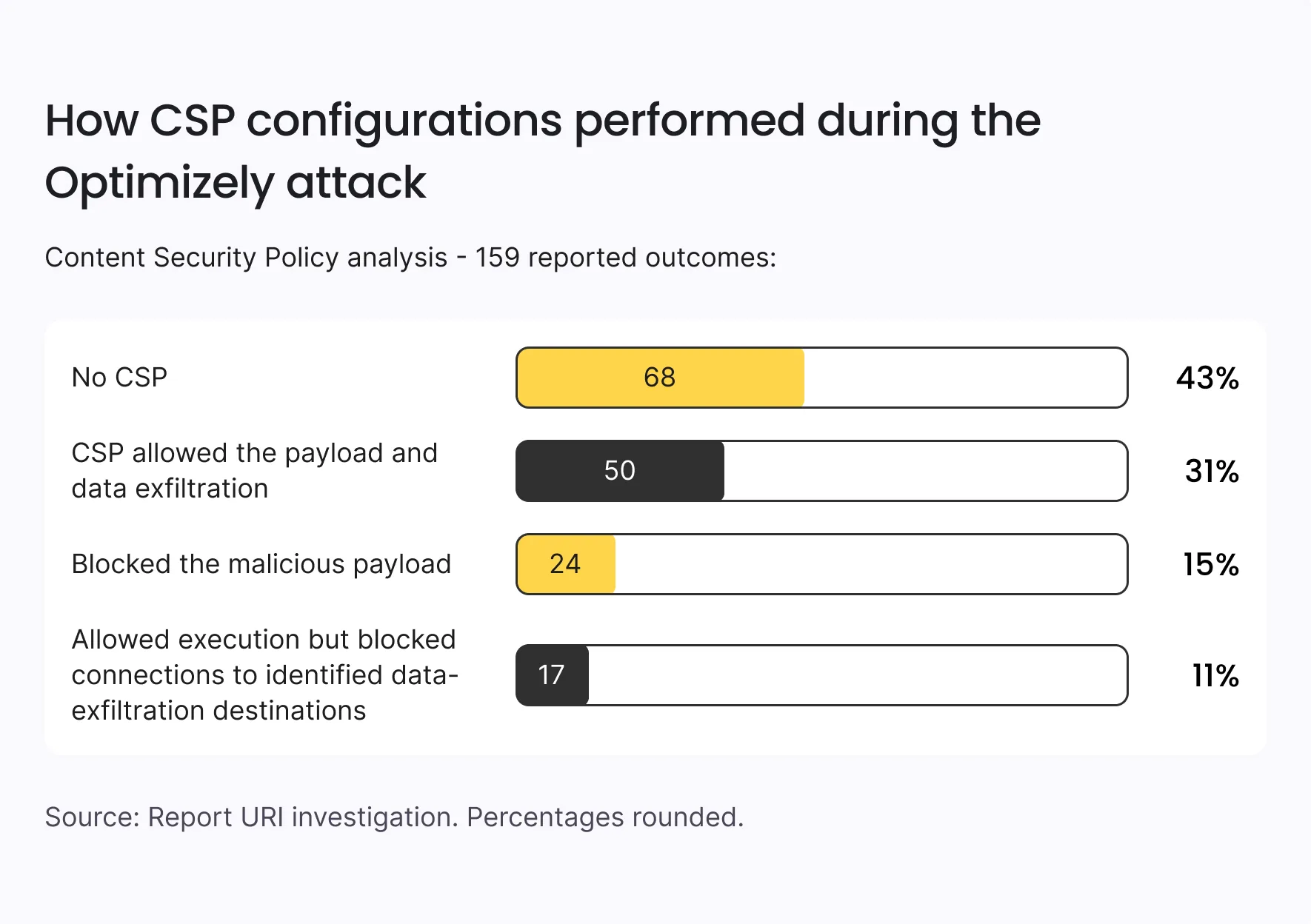
Among those organizations, 24 had policies that blocked the secondary malicious payload. Another 17 blocked connections to the identified data-exfiltration endpoints, although their visitors could still be exposed to on-page manipulation, including cryptocurrency wallet-address replacement. The remaining 118 organizations had no CSP or policies that did not block the identified malicious activity.
The results revealed substantial differences in protection. Some policies blocked malicious script execution entirely, while others restricted connections to identified data-exfiltration destinations or allowed both activities. The breakdown below shows how the 159 organizations' CSP configurations performed.
CSP is a browser security mechanism that controls which scripts can execute and which external services a website can communicate with. Its effectiveness depends on how these permissions are configured.
The findings show why organizations should regularly review security headers, restrict unnecessary external connections, and test their policies against realistic threats. Subresource Integrity can provide an additional safeguard for suitable static scripts by verifying that their contents match an expected cryptographic hash.
Continuous monitoring helps detect threats that preventive controls miss
A compromised third-party script can execute while a website continues operating normally. Pages load, forms work, and conventional uptime monitoring may report no disruption.
Security researcher Scott Helme described how Report URI's monitoring helped identify the Optimizely attack. Browser-side security reports revealed suspicious activity associated with scripts delivered through the platform.
For website owners, monitoring can help identify unexpected changes to external JavaScript, suspicious connections to unfamiliar domains, and Content Security Policy violations. These signals provide visibility into activity that conventional uptime and server monitoring may miss.
Monitoring should also cover security advisories and known vulnerabilities affecting CMS platforms, software dependencies, and infrastructure. Alerts need clear ownership and established response procedures so technical teams can investigate potential threats and take appropriate action.
The appropriate monitoring strategy depends on the website's complexity, integrations, and the sensitivity of the information it handles.
A third-party breach requires a coordinated response
When a third-party service is compromised, organizations need to identify affected integrations, assess potential risks to visitors, and coordinate an appropriate response.
Consider what happens when your organization receives a notification that a third-party service used on its website has been compromised.
Your team needs to answer the following questions:
- Where is the affected service used? Identify the pages, applications, and integrations that depend on it.
- Can it be disabled safely? Determine how to isolate the compromised service while preserving essential website functionality.
- What information may have been exposed? Review available logs, browser-side activity, and vendor findings to assess the potential impact.
- Who is responsible for the response? Establish who investigates, coordinates with the vendor, makes decisions, and communicates with stakeholders.
These responsibilities become easier to manage when organizations maintain an inventory of external dependencies and establish incident-response procedures before an attack occurs.
For websites supported by external development partners, the maintenance agreement should also define security responsibilities, escalation procedures, and the process for addressing urgent vulnerabilities.
Security updates are only one layer of protection
Incident response addresses immediate threats, while regular software maintenance helps reduce exposure to known vulnerabilities.
The malicious JavaScript distributed through Optimizely reportedly attempted to exploit vulnerabilities in older iOS versions. According to Reuters, Apple had already addressed the targeted vulnerabilities through security updates.
These attempts targeted visitors' devices. Updating a website's CMS would not have prevented the compromised third-party script from being delivered.
For website owners, timely software updates remain essential for reducing exposure to known vulnerabilities. An effective maintenance process should cover:
- CMS and extensions: Apply security updates to Drupal, WordPress, modules, plugins, and themes.
- Third-party dependencies: Track vulnerabilities in software libraries, packages, and connected systems.
- Hosting and infrastructure: Maintain supported server software, operating systems, and infrastructure components.
- Update prioritization: Address critical and actively exploited vulnerabilities promptly, using resources such as CISA's Known Exploited Vulnerabilities Catalog.
Security updates should follow a process that accounts for vulnerability severity, compatibility testing, and deployment urgency. Critical fixes may require an accelerated release process to reduce exposure.
Keeping Drupal, WordPress, and other software up to date remains essential. Combined with regular reviews of third-party dependencies, appropriate security controls, and clear response procedures, timely updates form part of a broader approach to website security.
How Five Jars approaches website security
Protecting a website requires coordinated attention to development, third-party integrations, security controls, and ongoing maintenance. At Five Jars, we incorporate these considerations throughout the lifecycle of client projects, from initial architecture and development to long-term support.
Our projects often involve complex digital platforms connecting content management systems, CRMs, membership and registration platforms, payment services, and other third-party applications. We consider security across these connections, including data flows, access permissions, infrastructure configurations, and software dependencies.
Our website security solutions help organizations identify vulnerabilities, assess risks, and strengthen their website's protection.
Security remains a priority after launch. Through our ongoing support agreements, we track relevant CMS and dependency security advisories, prioritize updates, review applicable configurations, and respond to identified issues based on the agreed scope of work.
Is your website ready for the security challenges of 2027?
The Optimizely attack raises four questions worth discussing with your technical team:
- Third-party integrations: Do you know which external scripts and services run on your website and what information they can access?
- Security controls: When were your website's security configurations last reviewed and tested?
- Monitoring and updates: Who monitors emerging vulnerabilities, investigates security alerts, and prioritizes critical software updates?
- Incident response: How quickly could your team identify and isolate a compromised third-party service?
Your answers can help identify security gaps and priorities for the coming year.
Let's talk about your website's security
Whether you're looking to assess potential vulnerabilities, review security risks across your website and third-party integrations, or strengthen your ongoing maintenance practices, Five Jars can help you identify priorities and develop an approach that fits your digital platform and organizational needs.