
Yet when reviewing real production systems, many teams still run a mix of outdated APIs, legacy rendering assumptions, and build tools that have been functionally deprecated. These systems continue working, but they accumulate hidden complexity:
- Slower builds
- Brittle hydration
- Mismatched server/client code paths
- Shrinking ecosystem of compatible modules
At Five Jars, we encounter these challenges not only in client projects but also in our own product development. Both a data orchestration platform Deyra AI and a cloud digital signage CMS Screen Pulse are actively built and maintained using Vue-based architectures, which gives us direct, long-term exposure to how these tools behave as products scale, requirements evolve, and ecosystems shift.
Vue in 2026: Stable foundation, evolving practices
Vue 3 has been the primary release since February 2022, and Vue 2 officially reached end of life in December 2023. By 2026, the ecosystem will fully consolidate around Composition API, <script setup>, and TypeScript-compatible patterns. Vue is not undergoing rapid churn, but it is opinionated about which patterns should be considered legacy.
What’s stable
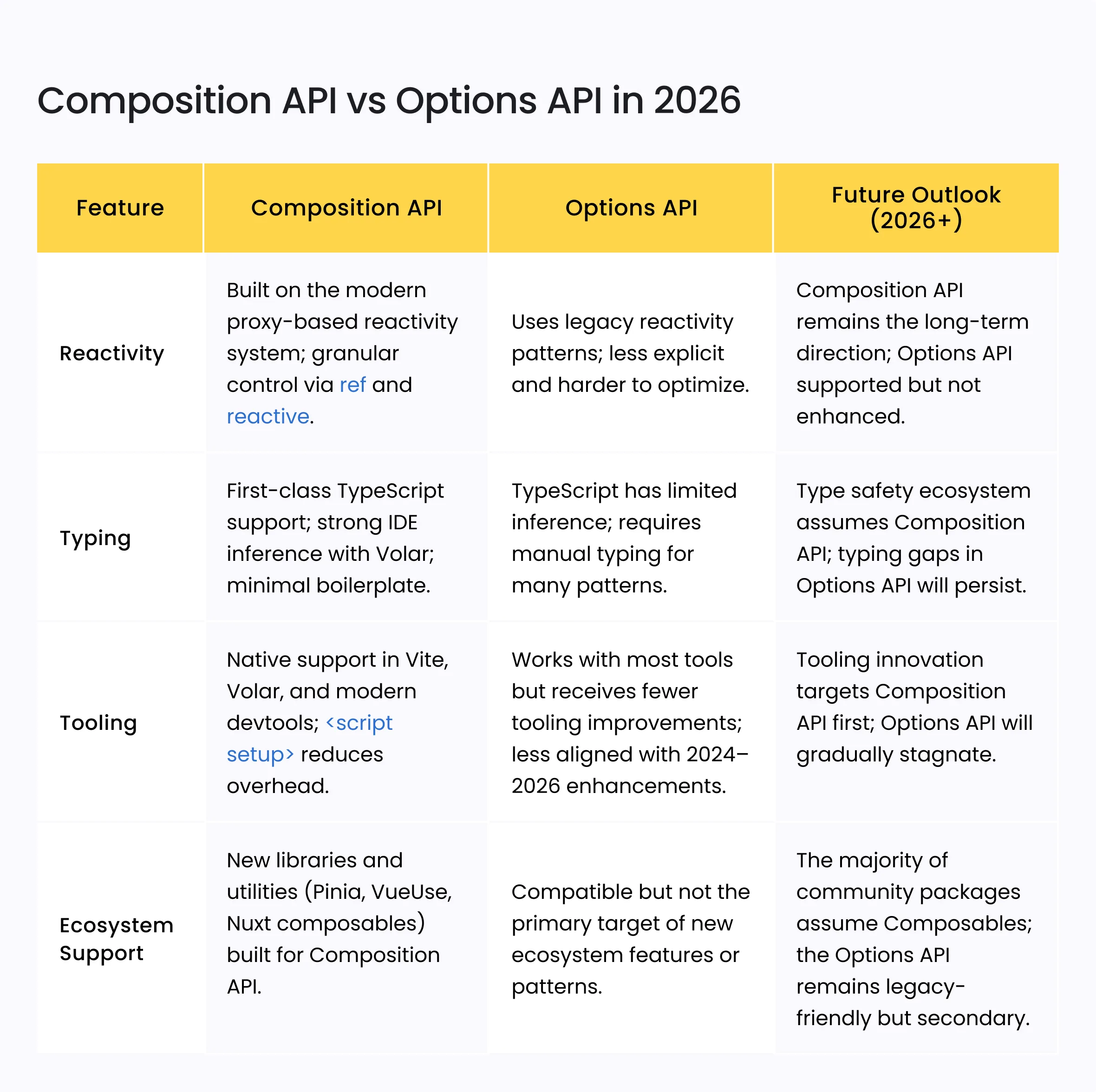
Vue’s reactivity system, component model, and rendering engine are stable and well-understood. The Composition API is no longer the new option; it is the default way new Vue libraries are written. The Options API still works, but many new ecosystem utilities assume composables.
In our product development work, Composition API has proven especially valuable for maintaining complex state flows and shared logic over time. As products grow, composables offer clearer boundaries and significantly reduce hidden coupling between components – an advantage that becomes more noticeable with each release cycle.
What’s outdated
Patterns from Vue 2 continue to surface in audits of older systems:
- Filters (removed in Vue 3; Vue 3 Migration Guide)
- Event buses as a state-sharing mechanism (discouraged since Vue 3 RFC discussions)
- Global mixins (discouraged due to implicit behavior)
- Vuex 3/4 (official docs recommend Pinia instead)
Most of these do not break a production build, but they increase long-term maintenance costs and reduce compatibility with modern tooling.
What teams should update
- Replace Vuex with Pinia
- Remove mixins and Filters
- Adopt <script setup> in new development
These updates will bring the codebase into alignment with how the broader Vue ecosystem expects components to behave in 2026.
Nuxt in 2026: The Framework has evolved faster than many codebases
Nuxt has experienced the most dramatic evolution of the three technologies. Nuxt 3 (released stable in late 2022) introduced a new server engine (Nitro), new rendering modes, a new routing approach, auto-imports, and deep Vite integration.
Teams still running Nuxt 2 in 2026 will operate an architecture that is fundamentally incompatible with how Nuxt is designed today.
The 2026 Nuxt model
Nuxt is now a server-first framework built around:
- Nitro, a universal server engine capable of running on Node, serverless, and edge environments
- File-based server routes (/server/api) replacing Express/Koa middleware
- Auto-imports for composables and utilities
Hybrid rendering modes (SSR, SSG, ISR, edge rendering) via Route Rules - Layers, enabling organizations to maintain shared design systems and common configuration
These changes solved long-standing pain points, especially deployment complexity, but they also rendered many Nuxt 2 patterns obsolete.
We see this shift clearly in our own products, where Nitro-based server routes simplify backend logic and reduce the need for separate Node services. The tighter coupling between rendering, data fetching, and caching has been especially valuable for products that need both speed and flexibility.
What breaks across versions
Nuxt 2 → Nuxt 3 is not a drop-in migration. In older codebases, you may find:
- Webpack-based builds no longer supported
- Vuex stores incompatible with composable state
- Plugins relying on context injection, now replaced by modern hooks
- Middleware written using legacy APIs
- Environment variable handling that no longer maps to runtime config
Nuxt’s migration guide calls these changes out explicitly; they reflect structural shifts, not cosmetic API updates.
What teams should update
For Nuxt codebases, these are high-impact updates:
- Move server logic to Nitro (/server/api)
- Replace Vuex with Pinia
- Rewrite plugins using auto-import patterns
- Clean up routing assumptions (Nuxt 3 has stricter nested routing behavior)
- Enable TypeScript (Nuxt ships with it by default)
Engineering teams often underestimate Nuxt migrations because the “Vue” part feels familiar. But the real complexity lies in server boundaries, rendering assumptions, and module compatibility.
Vite in 2026: The established standard for Vue and Nuxt
In 2026, Vite is the default bundler for Vue and Nuxt, but also for Svelte, Solid, Astro, and others. Vue CLI is officially in maintenance mode (Vue CLI deprecation notice), and Webpack is increasingly a legacy dependency in front-end frameworks.
Why Vite matters
Vite brought three improvements that affect every project still on Webpack:
- Faster development: instant server start and lightning-fast HMR
- More predictable builds: powered by Rollup’s stable bundling
- Simpler configuration: fewer loaders, more defaults
These benefits accumulate significantly over 3-5 years of a project’s life.
Across our projects we are part of, moving to Vite significantly reduced build times and lowered the cost of onboarding new developers. These gains become more pronounced as the codebase grows and CI pipelines become more complex.
When staying on Webpack is a risk
If your project exhibits any of the following, it’s time to migrate:
- Build times over 60-90 seconds
- Complex, interconnected loader chains
- SSR code paths that behave differently between dev/prod
- Frequent HMR crashes on large pages
- Dependency conflicts due to older Webpack versions
What teams should update
- Replace Vue CLI or Webpack configs with Vite-native setup
- Clean up env variable usage to use import.meta.env
- Remove unused loaders and plugins
- Revisit SSR assumptions (Vite expects explicit separation of server/client code)
Vite is not a new tool anymore; it’s the foundation of most modern JavaScript frameworks.
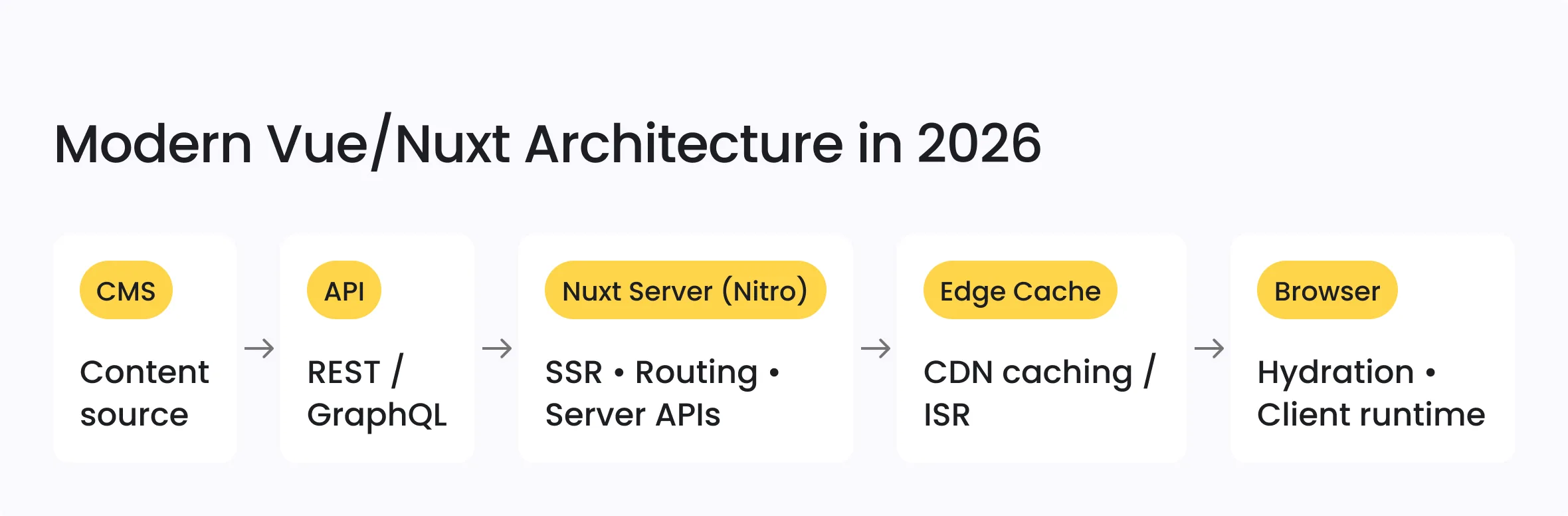
How these technologies fit together in 2026 architectures
Most mid- to large-scale teams today use Vue/Nuxt/Vite in one of these scenarios:
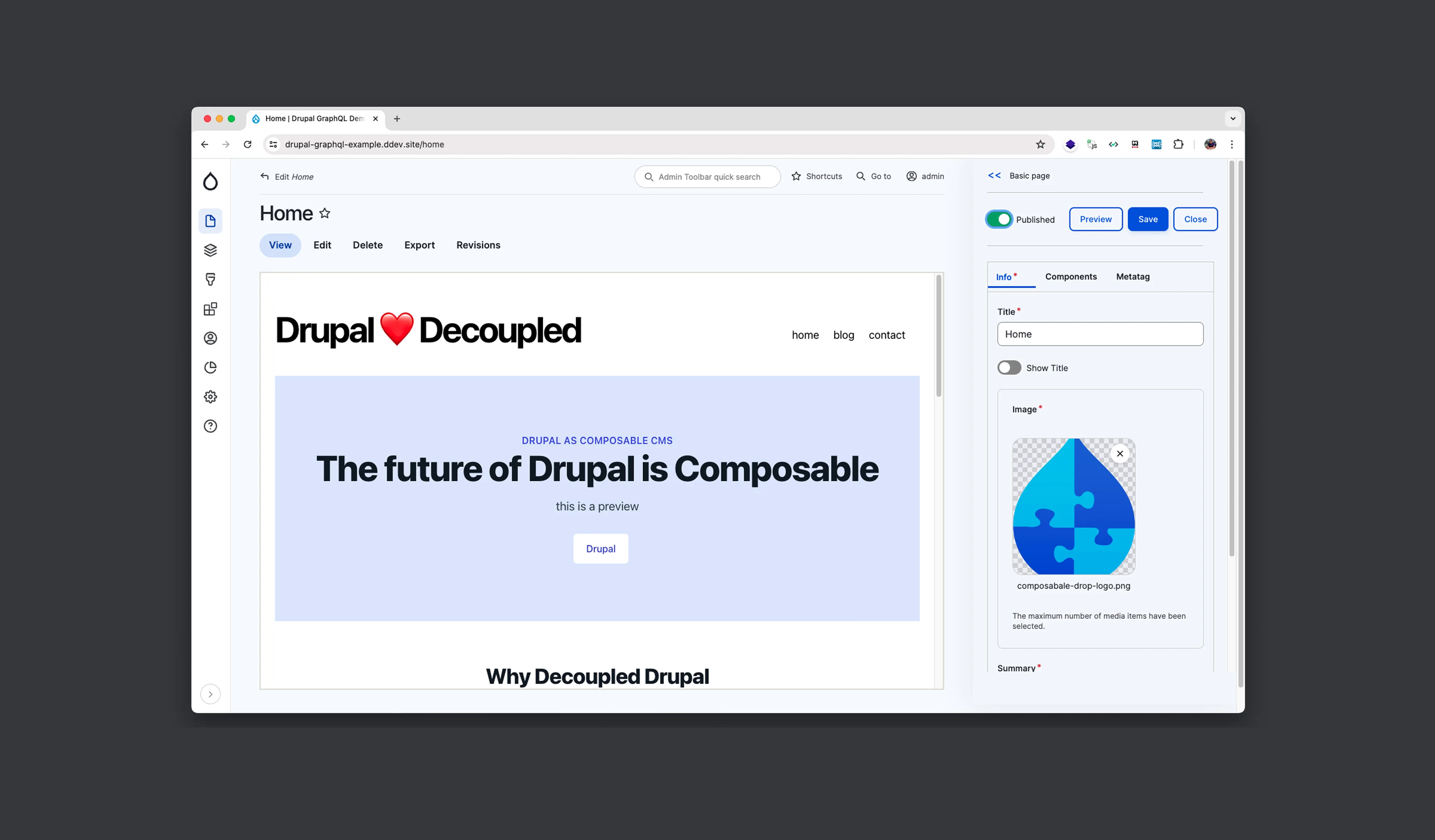
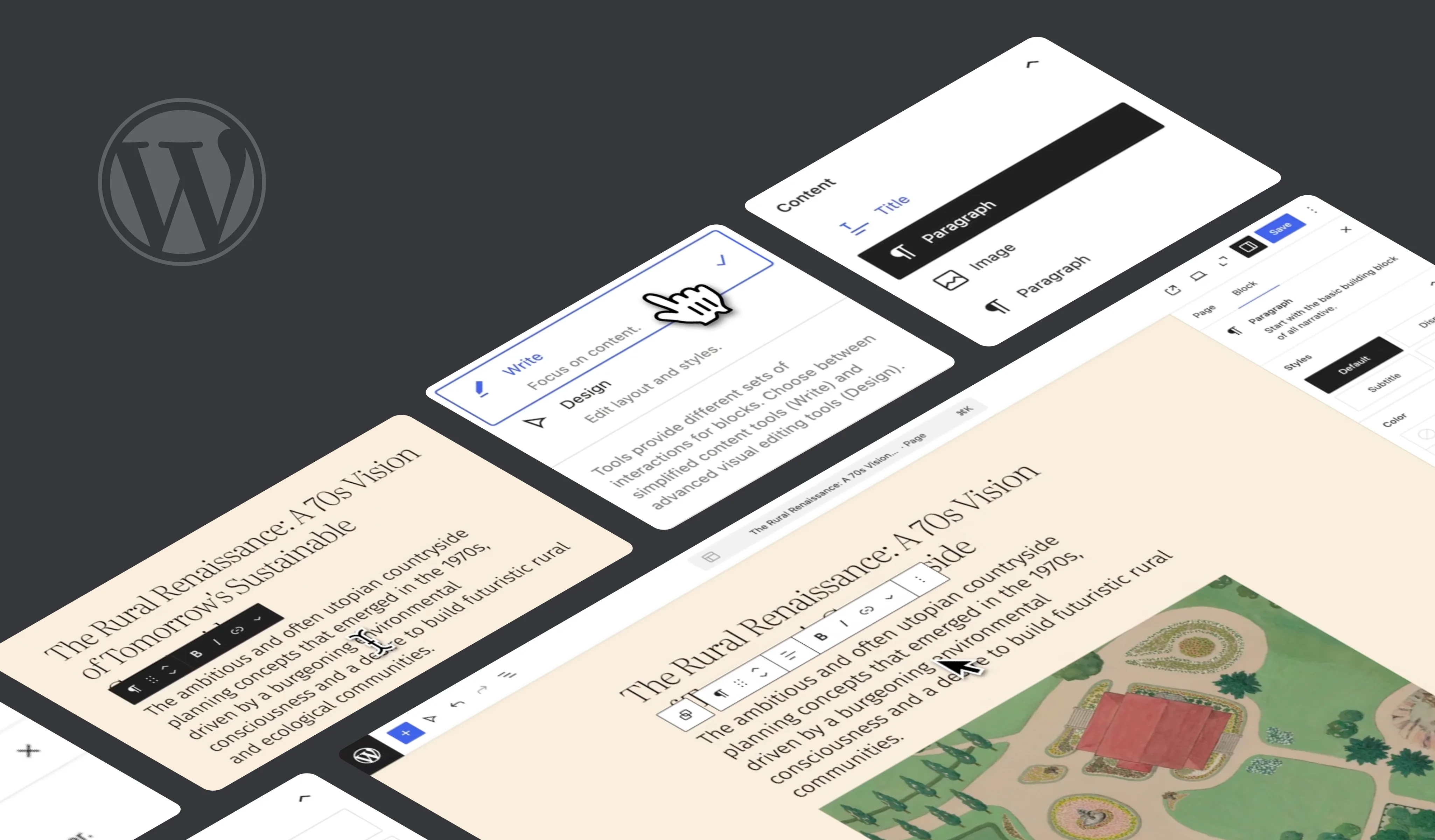
- A headless CMS frontend (Drupal, WordPress, Contentful, Sanity)
- A standalone node service with server-rendered UI
- An edge-rendered application optimized for performance
- Progressive adoption within an existing monolith
A common architectural problem in older builds is inconsistent boundaries between server and client code, leading to hydration mismatches or caching issues. Modern Nuxt + Vite tooling makes these boundaries clearer and easier to enforce, but only if the codebase adopts the newer conventions.
Risk assessment: What is safe and what is becoming legacy
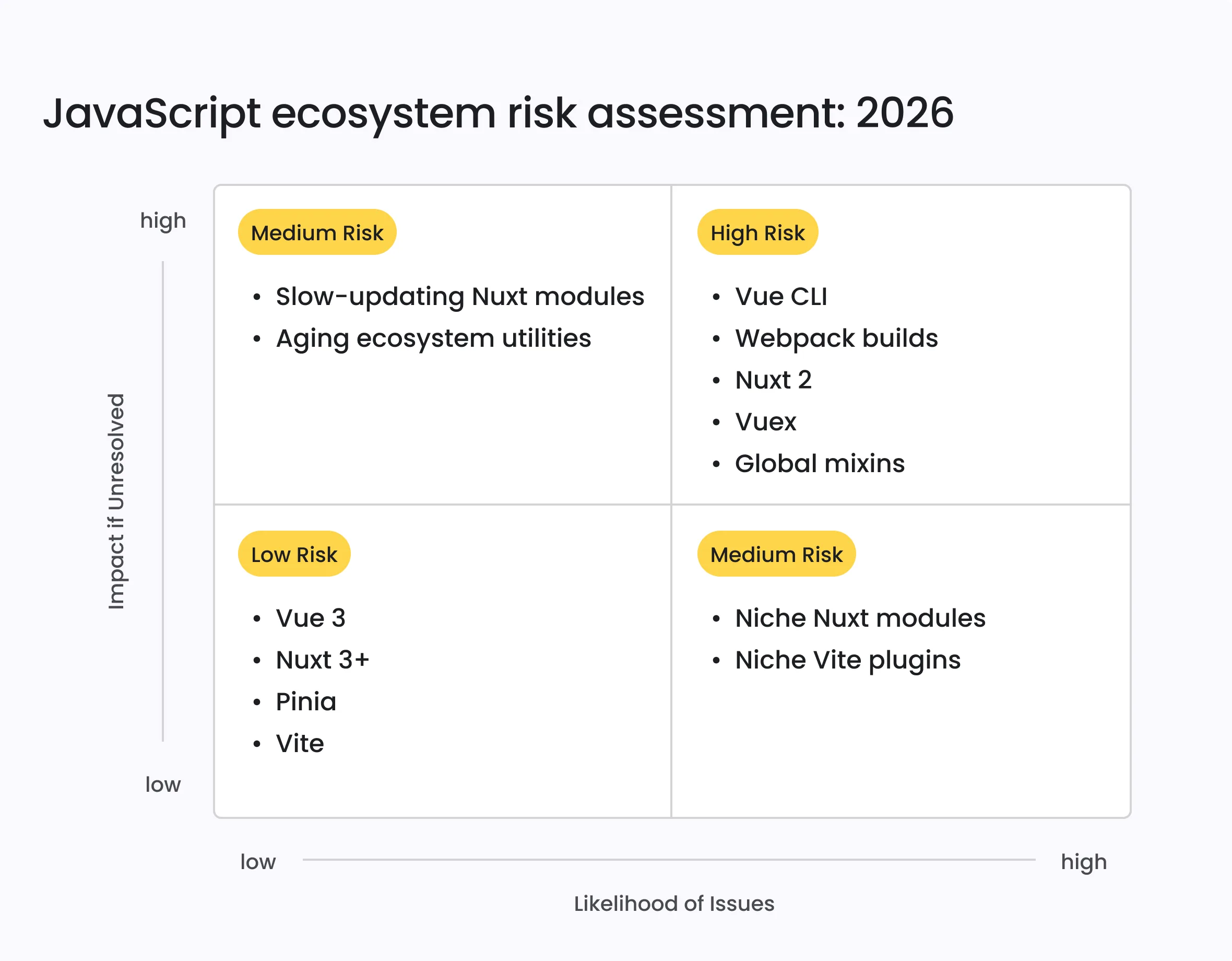
Not every part of the Vue/Nuxt/Vite ecosystem carries the same long-term reliability. Some tools are actively maintained and aligned with the direction of the core teams, while others remain functional but are slowly falling behind or are already considered legacy.
To make decisions about modernization, it helps to look at risk along two dimensions:
- Impact if unresolved. How costly it becomes to keep the old approach.
- Likelihood of issues. How often will breakage, compatibility problems, or ecosystem drift occur?
Low-risk technologies are stable, well-supported, and future-oriented.
Medium-risk areas work today but may bring maintenance friction or slower updates.
High-risk items are deprecated or aging tools that increasingly limit performance, compatibility, and developer experience.
The matrix below summarizes where key technologies currently fall in 2026.
Migration priorities for 2026
Once you understand which parts of the ecosystem carry the most risk, the next step is deciding what to update and in what order. Not every improvement has the same impact on stability or developer productivity. Some upgrades remove major architectural bottlenecks, while others simply align the codebase with cleaner conventions.
The priorities below reflect a balance of ecosystem direction, maintenance cost, and the effort required to modernize. Items in the highest-priority group address structural issues that will only become more expensive to fix later, while lower-priority updates can be introduced gradually as part of ongoing development.
Highest priority (Do now)
- Nuxt 2 → Nuxt 3+
- Vue CLI/Webpack → Vite
- Vuex → Pinia
- Remove mixins, Filters, and legacy hooks
Medium priority
- Adopt <script setup> for new development
- Update routing and plugin conventions
- Switch to Vitest from older Jest setups
Low Priority
- Refactor UI-only components
- Unify naming conventions
- Replace small utilities with composables
Engineering checklist 2026 for the JavaScript ecosystem
A modernization effort is easier to plan when teams can see the state of their current setup at a glance. This checklist highlights the most common indicators of outdated architecture, tooling gaps, and maintenance risks. It can be used during quarterly audits, before major feature work, or when estimating the scope of a migration. If several items surface as needs review, it’s a strong sign that the codebase would benefit from a structured upgrade plan.
Architecture
- Are you using Nitro server routes?
- Do SSR hydration warnings exist?
Tooling
- Does Webpack still appear in your build steps?
- Does dev server start instantly (Vite) or slowly (Webpack)?
Code Quality
- Any mixins left?
- Still using Vuex?
- Are components typed?
Performance
- Build times under 60–90 seconds?
- Are the routes split effectively?
Maintenance
- Dependencies within two major versions?
- ESLint/Prettier/TypeScript aligned with 2026 conventions?
Wrapping up
By 2026, the Vue, Nuxt, and Vite ecosystem is stable and well-defined. Most challenges teams face today come not from the frameworks themselves, but from architectural choices that no longer align with how the ecosystem has settled: outdated patterns, legacy tooling, and unclear server–client boundaries.
At Five Jars, we work with these technologies daily, including in our own recently launched products, Deyra AI and Screen Pulse. Building with modern defaults, Nuxt’s server-first model, Vite-based builds, and composable-driven architecture, gives us a clear, current view of what works well today and what is likely to age poorly.
If you’re planning a new product, a major rebuild, or a gradual modernization of an existing system, having the right technical perspective early can save significant time and rework later.
If you’d like to discuss your broader digital strategy or get a second opinion on your technical direction, contact us. We’re always happy to start with a conversation.