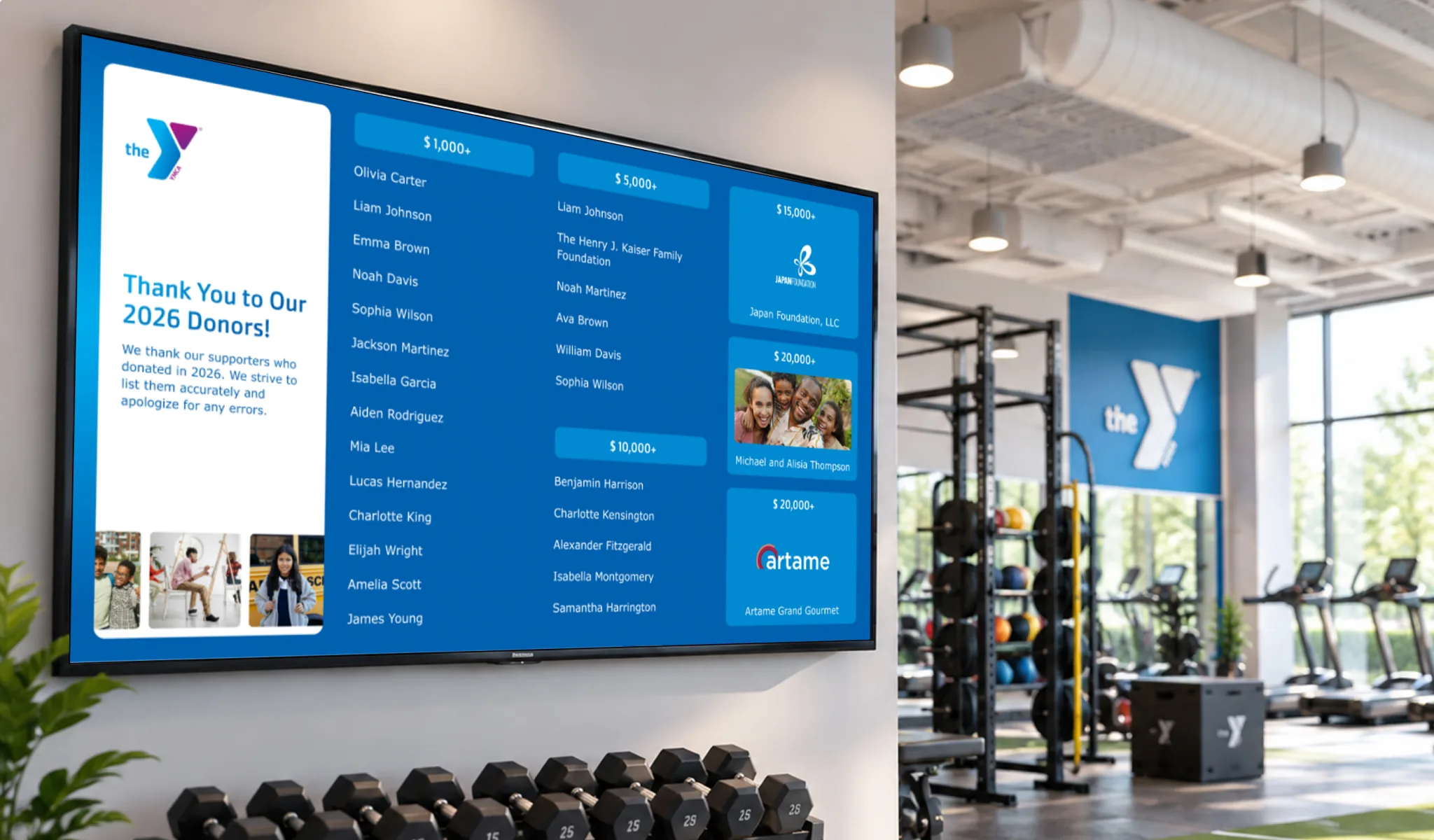
After years of working with YMCAs, we’ve noticed an interesting disconnect. Fundraising has become increasingly sophisticated, but donor recognition inside the branch can still be surprisingly static.
A Y may have an Annual Campaign, major donors, corporate partners, event sponsors, giving societies, and in-kind supporters, all with different relationships to the organization. Yet on screens, recognition can still come down to a donor list, a rotating sponsor slide, or a graphic someone has to remember to update.
We don’t think the problem is the donor wall. Permanent recognition has its place. The more interesting question is what happens beyond it.
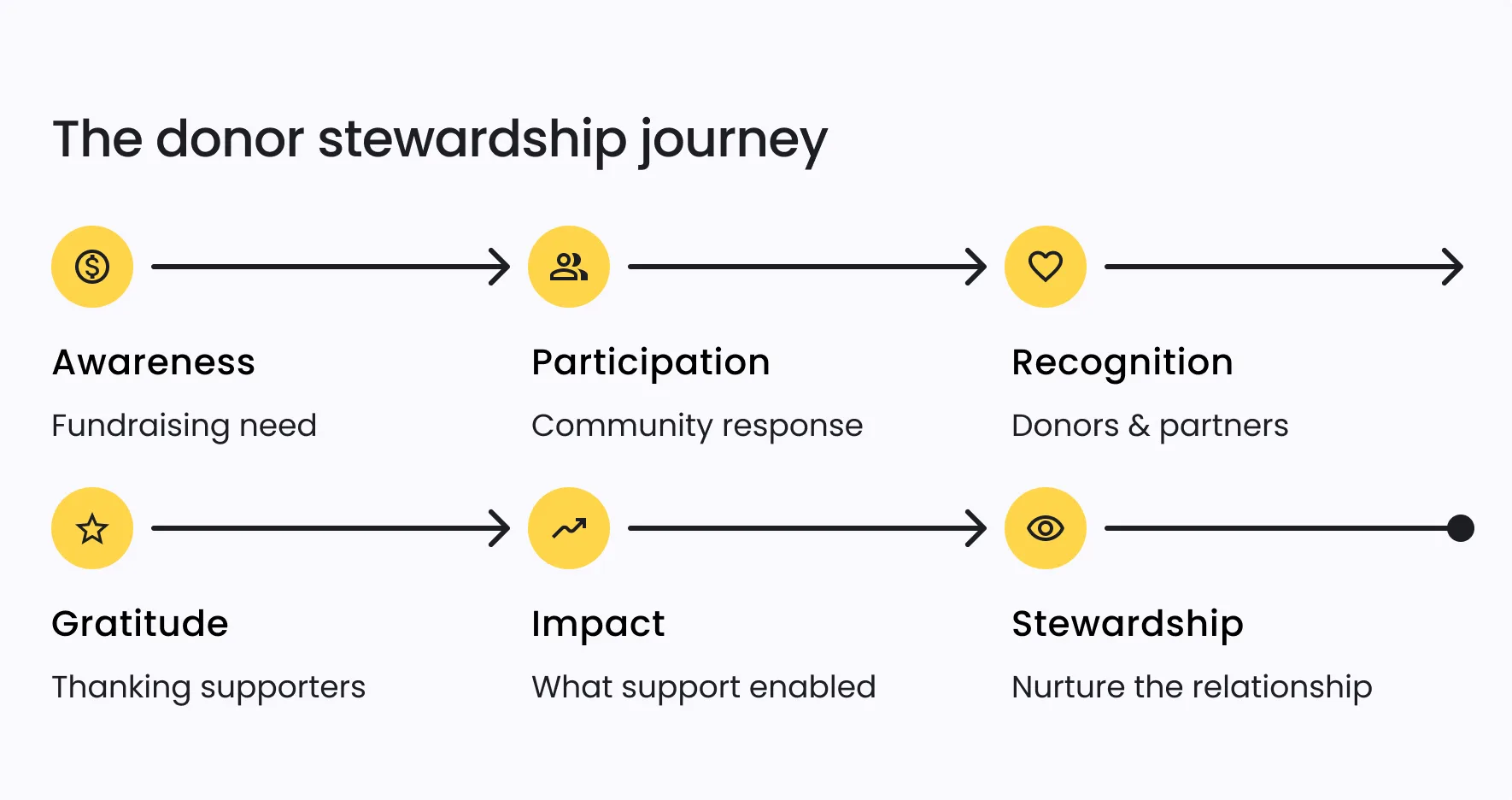
Recognition is part of donor stewardship. A Y has reasons to communicate with and about its supporters before, during, and long after a gift: making a need visible, showing community participation, thanking people, fulfilling sponsorship commitments, sharing what their support made possible, and continuing to recognize the relationship. And Ys already have a channel for doing more of this inside their facilities: the screens their communities see every day.
Why we’re looking at donor recognition
Five Jars has spent years working across the YMCA digital ecosystem, connecting websites, member experiences, operational systems, schedules, and in-branch communication.
Across that work, we’ve seen the same challenge in different forms: organizations already have the information they need, but using it across websites, screens, and other channels often creates additional work. Donor recognition presents the same opportunity. Supporter data already exists; the question is how to turn it into relevant recognition across screens efficiently.
That thinking has directly shaped Screen Pulse, our digital signage software, and how we’re approaching donor and sponsor recognition within it.
Make screens part of donor stewardship
What makes in-branch screens particularly useful for donor recognition is where they sit: inside the environment that donors, sponsors, and community partners are helping support.
That gives recognition context. A campaign story can appear alongside the programs it supports. Fundraising progress can be visible to the community contributing to it. A corporate partner can be recognized in the branch where its support is felt. And the same screens can later connect that support with an outcome or story from the Y.
For YMCAs, this creates an opportunity to make screens part of the broader stewardship relationship: building awareness, encouraging participation, recognizing support, expressing gratitude, showing impact, and continuing stewardship.
Different support deserves different recognition
The range of support a YMCA recognizes goes well beyond a traditional donor list. Annual Campaign donors, major donors, giving societies, corporate partners, event sponsors, and in-kind supporters may all support the same Y, but the nature of those relationships and the recognition attached to them can be very different.
Current YMCA fundraising and sponsorship programs show how varied that recognition can be:
- Crossroads YMCA includes recognition on branch TVs for 12 months as part of its corporate sponsorship package.
- Piedmont Family YMCA offers year-round recognition on lobby digital monitors, as well as digital sponsor slides displayed for three or six months depending on the sponsorship level.
- Greater Green Bay YMCA uses electronic banners across five branches, with higher giving levels adding recognition options such as a photo, message, or company logo.
Together, these examples show that YMCA digital recognition can vary by location, duration, sponsorship level, and recognition format.
Digital donor recognition gives YMCAs room to reflect these different relationships in different ways:
- Annual Campaign donors – gratitude walls or donor listings
- Major donors – individual stories and spotlights
- Giving societies – recognition organized by giving level
- Corporate partners – sponsor recognition
- Event sponsors – recognition tied to a specific event
- Impact stories – connecting supporters with what their contributions helped make possible
This thinking has influenced how we’ve approached donor recognition in Screen Pulse, with a growing library of recognition options covering donor walls and listings, individual spotlights, sponsor and event recognition, giving societies, campaign progress, and impact stories.
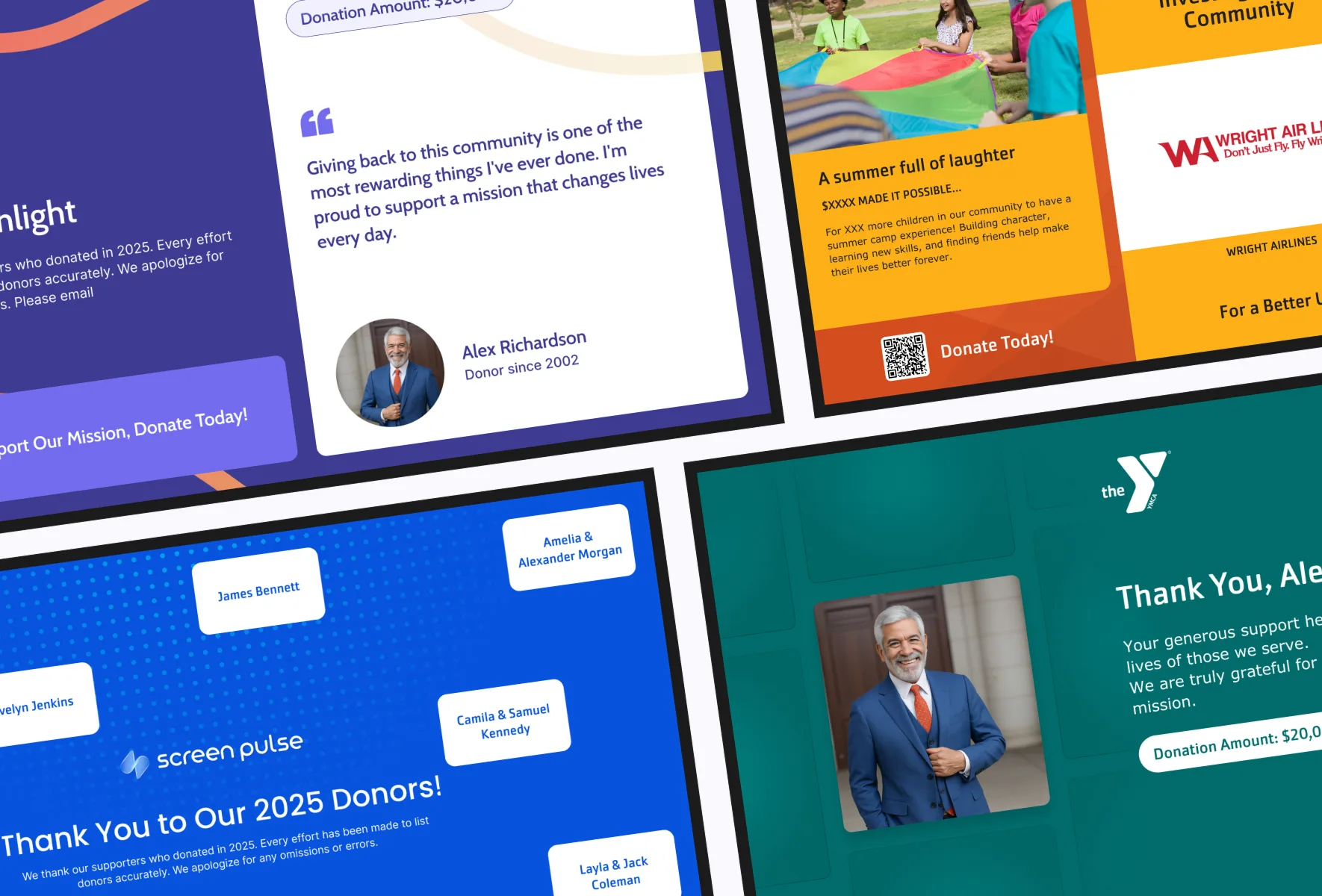
The number of recognition formats isn’t really the point. The more important shift is separating who is being recognized from how they are recognized. The supporter information can remain consistent while the recognition changes with the relationship, giving level, context, or moment. Recognition can also change over time.
Some recognition has a start and end date
The YMCA examples above highlight another important part of donor and sponsor recognition: visibility often comes with a defined period. Depending on the sponsorship level or agreement, recognition may run for a few months, an event, a campaign, or a full year.
That makes timing part of the recognition commitment. The right sponsor needs to appear in the right places for the agreed period, with recognition starting and ending according to the terms of the relationship.
As the number of partnerships, recognition levels, events, branches, and screens grows, so does the number of dates and placements to coordinate. Managing those periods directly as part of the supporter information makes it possible for screen recognition to follow the agreement automatically.
Screen Pulse Recognition Periods allow a donor, sponsor, or partner to have a defined start and end date for screen recognition. Screen Pulse uses those dates to determine when the supporter appears and automatically stops displaying the recognition once the period ends.
It’s a relatively small piece of automation, but it reflects a broader principle: recognition should follow the terms of the relationship automatically.
And timing is only one part of keeping recognition current. Donor lists change, giving levels change, new supporters are added, and the same information may need to appear in several different formats.
Recognition shouldn’t create another content workflow
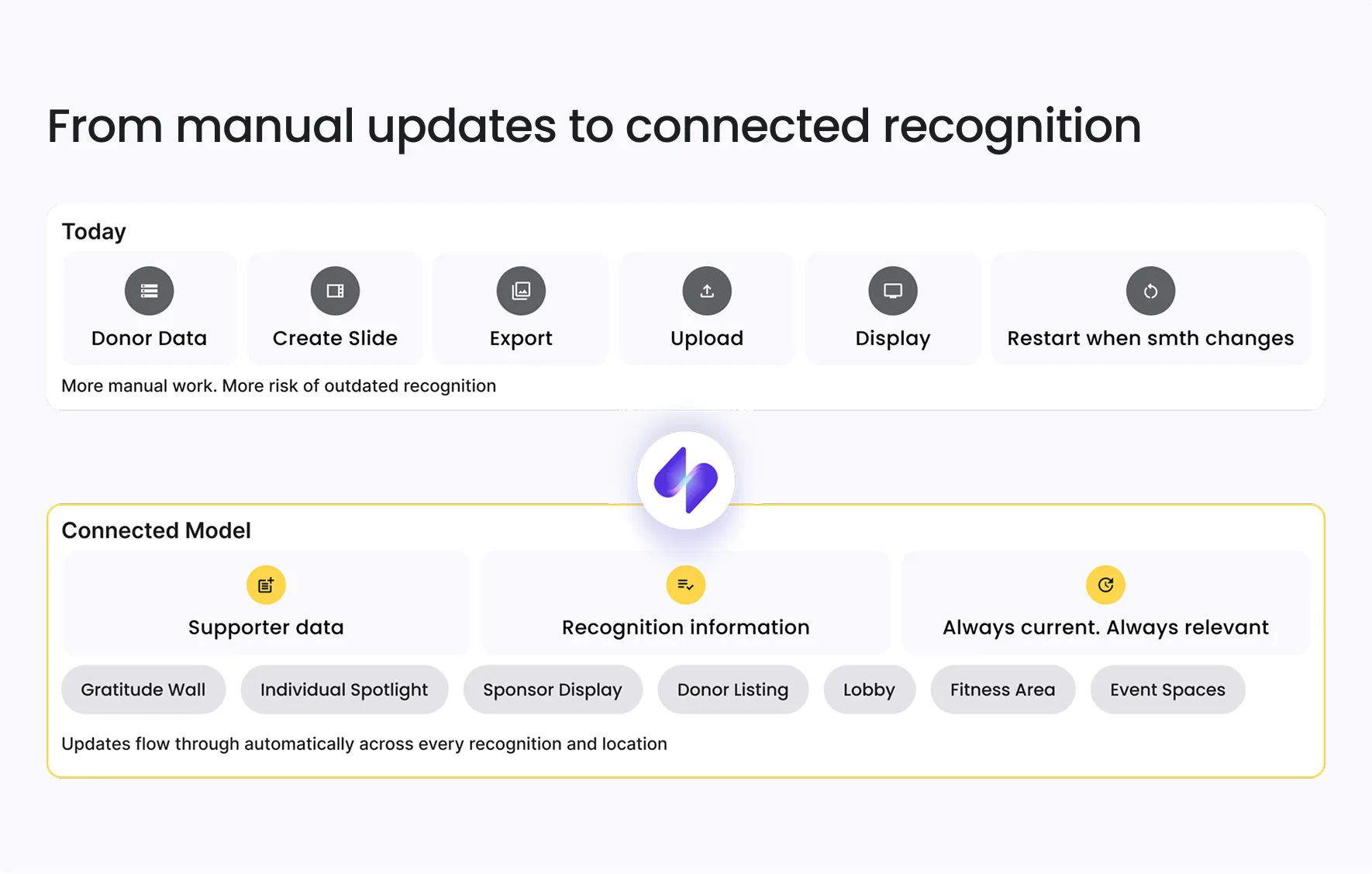
Recognition changes over time. New donors join. Sponsorship levels change. Campaigns bring in new supporters. Logos and recognition messages are updated. And the same supporter may need to appear in different ways across multiple screens or branches.
When recognition is built as individual slides or graphics, each change can become a separate content task. The workflow often looks something like:
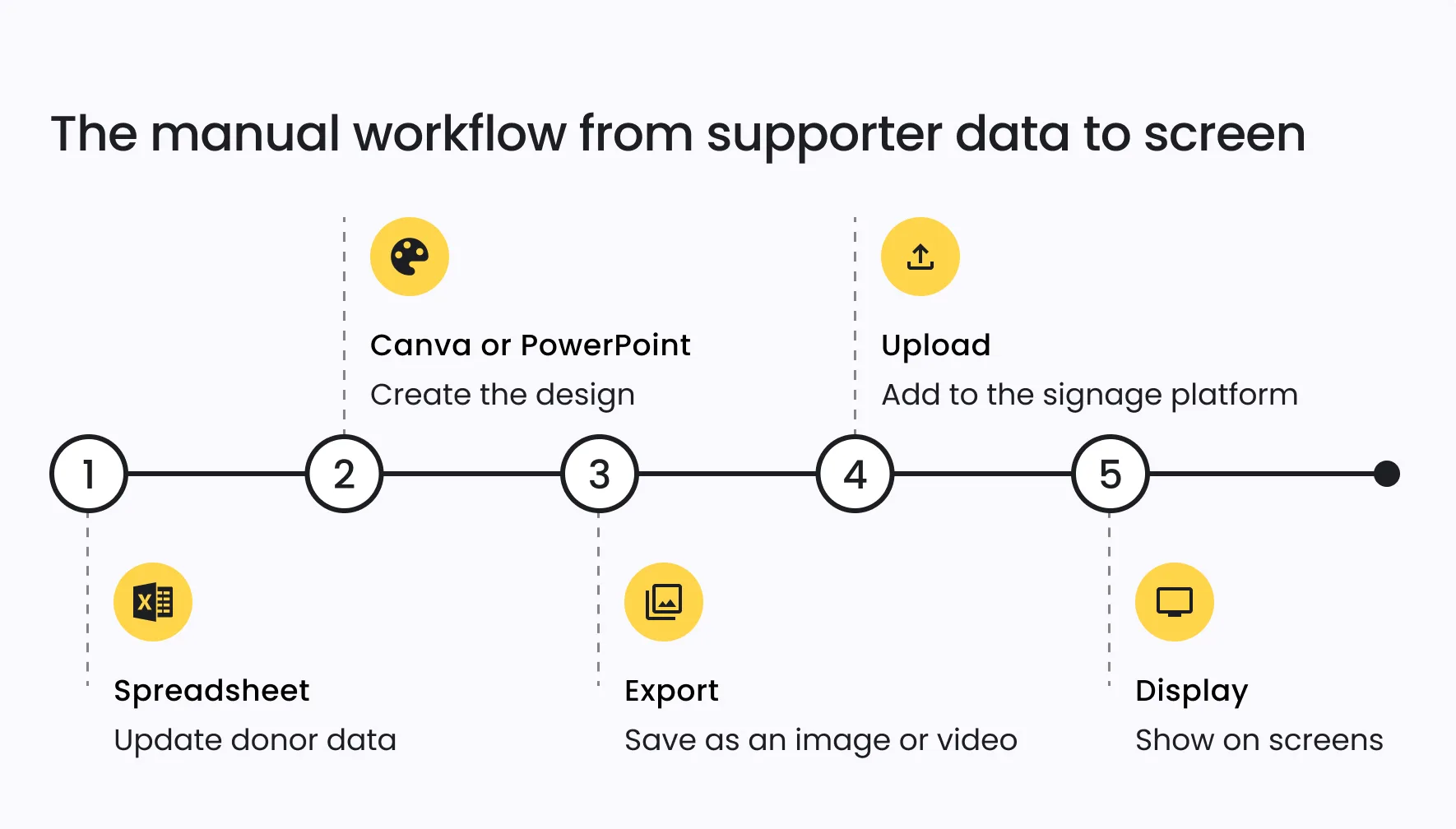
Then the process repeats for another screen, another branch, or another type of recognition.
The supporter information itself already exists. Fundraising teams know who their supporters are, how they should be recognized, which recognition level they belong to, and how long that recognition should remain active. The opportunity is to use that information directly to power what appears on screen.
That is the model we’re building in Screen Pulse. Donors, sponsors, partners, and in-kind supporters can be managed in one place, together with information such as recognition levels and active periods. The same supporter data can then power different recognition experiences: a donor listing in one context, an individual spotlight in another, or sponsor recognition elsewhere.
The distinction is simple but important: supporter information can stay consistent while the way it appears changes across recognition experiences.
And if fundraising teams already maintain that information in other systems, the next question is how much of it needs to be maintained in Screen Pulse at all.
Donor data working more like schedule data
There is a useful parallel with something Ys have already addressed elsewhere in their digital experience: schedules.
Class and program information changes constantly. When that information already lives in Traction Rec, Daxko, YMCA 360, GroupEx Pro, Upace, or another system, the more efficient model is to connect screens to the source and let changes flow through automatically.
Donor recognition raises a similar question. Fundraising teams already maintain donor names, giving levels, sponsorship details, recognition periods, and other supporter information. That data can also become the source for what appears on screen.
If you wouldn’t rebuild your class schedule every time it changes, why rebuild donor recognition every time your supporter information changes?
This is the direction we’re taking with Screen Pulse. Supporter information can be managed directly in Screen Pulse, imported from CSV, or connected through sources such as Google Sheets, Microsoft Excel, and externally hosted CSV files. We’re also working toward direct integrations with fundraising platforms such as Blackbaud, Bloomerang, Givebutter, and Salesforce Nonprofit Cloud.
The goal is to let fundraising teams maintain supporter information where it already belongs while making that data usable for recognition across the screen network.
We’ve solved this type of problem before
Five Jars has worked with YMCAs for years on the same underlying challenge across websites, member experiences, schedules, and digital signage: information should move between systems instead of being recreated for every channel.
Our work with the YMCA of Greater Brandywine on connecting real-time schedules, in-branch digital signage, and donor recognition is one example. We helped bring schedule data from the Y’s existing systems onto its website and screens inside its branches, while also creating digital displays for donor recognition.
Screen Pulse extends that same connected approach into a platform YMCAs can use across their screen networks, making it easier to turn information they already maintain into relevant, up-to-date screen experiences.
The screen network is already there
For many YMCAs, the screen network for donor and sponsor recognition is already in place. Screens are part of the branch experience, appearing in lobbies, fitness areas, program spaces, check-in areas, and other high-traffic locations.
That existing network creates opportunities to bring recognition closer to the programs, people, and communities that supporters are helping make possible.
A lobby screen might move between program information and an Annual Campaign gratitude wall. A fitness-area screen can include corporate partner recognition alongside schedules and other content. Event screens can recognize sponsors during an event. And across a multi-branch Y, recognition can be tailored to the supporters and relationships connected with each community.
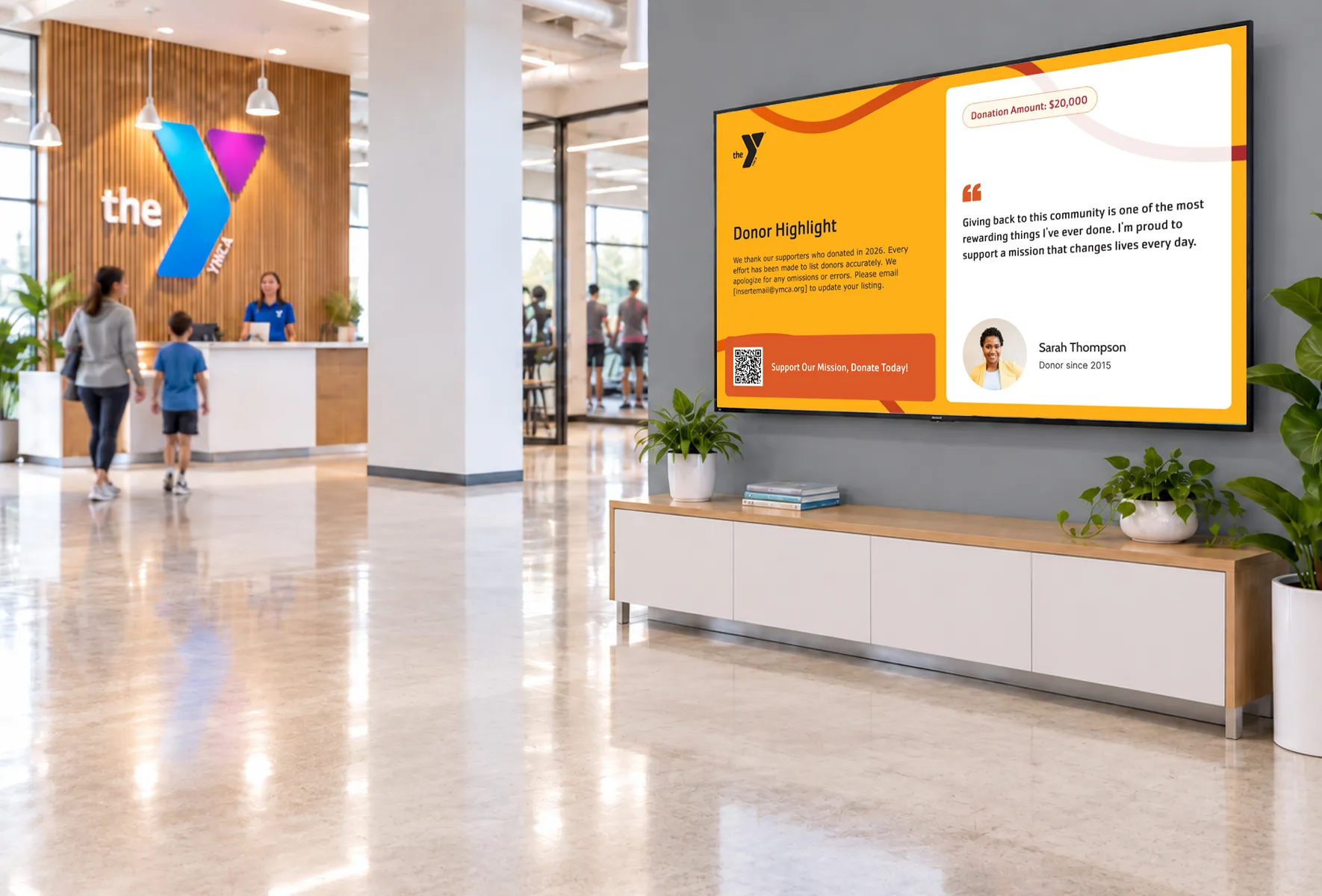
This is an important distinction between adding a digital donor wall and making donor recognition part of YMCA digital signage. The same screens can support schedules, programs, marketing, events, announcements, videos, and everyday communication while also becoming part of the recognition experience offered to donors and partners.
The opportunity is already there: use the existing screen network more intentionally as part of fundraising and donor stewardship.
Beyond the donor wall
The more we’ve looked at donor recognition through our work with YMCAs, the less it looks like a standalone signage use case.
It sits at the intersection of fundraising, marketing, partnerships, and the experience people have inside the Y. Supporter information may live in a fundraising platform, recognition commitments may vary by relationship or giving level, and the final experience may appear on screens across several branches.
For YMCAs, digital donor recognition can combine supporter data, recognition rules, existing screens, and different display formats to support donor stewardship, sponsorship fulfillment, fundraising communication, and ongoing recognition across branches.
This is part of a broader pattern we’ve seen through Five Jars’ work in the YMCA digital ecosystem: websites, member experiences, operational systems, fundraising platforms, and in-branch communication work better when information can move between them and reach the right channel.
For donor recognition, that means creating a more connected model: supporter data stays closer to its source, recognition reflects the type and duration of the relationship, and existing screen networks become another useful part of fundraising and stewardship.
Permanent donor walls will continue to have an important place. The opportunity around them is much bigger: to make recognition a living part of how the Y communicates support, partnership, and impact.
Next Step in Your YMCA Digital Experience
Whether you're looking at donor recognition, fundraising integrations, your website, or a broader YMCA digital ecosystem, Five Jars can help map how the systems and channels should work together.
If donor and sponsor recognition is your immediate priority, explore how Screen Pulse helps manage supporter data and turn it into different recognition experiences across your screen network.